Ledger · No. 4 ·
How bookselling went online, then on vacation
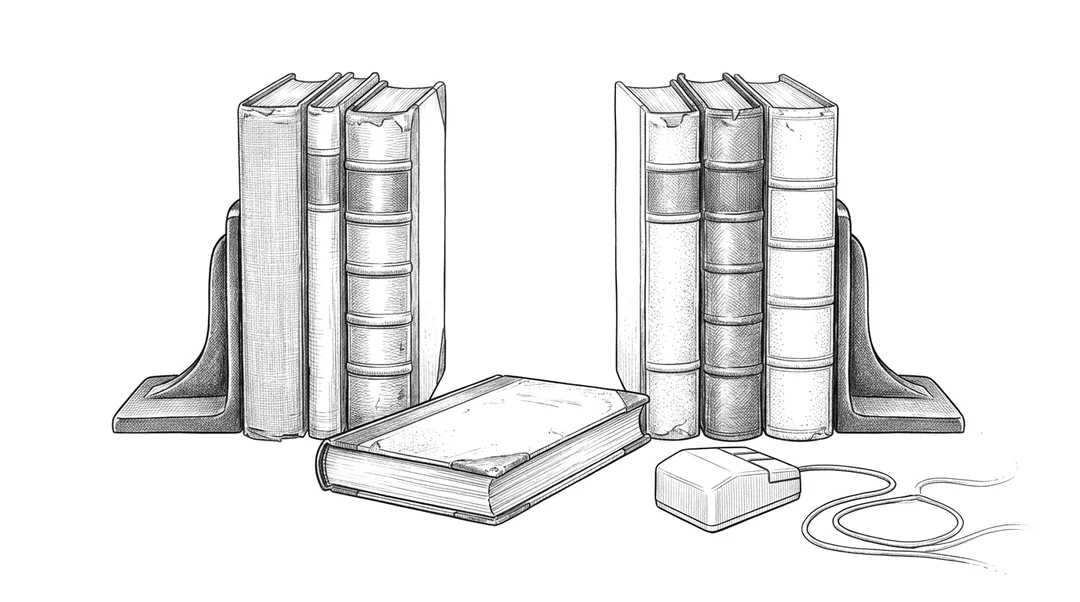
Eight years ago this month, nearly 600 booksellers took their books off AbeBooks, the Amazon-owned marketplace for second-hand and rare books, in protest at its plan to drop dealers in four countries. Two days later AbeBooks backed down. Here’s how my trade came to be striking against a shop window it had helped to fill, from the listing services of the 1990s to where dealers sell now.
Why the trade went first
Second-hand and rare books were an internet business waiting for the internet. A dealer’s whole job is putting one particular copy in front of the one person who wants it, who might live anywhere, and for the first half of my working life we did it by catalogue and post. So the trade went online early, and it went first to itself. From 1994 a service called Interloc let dealers buy from one another over a private network. In May 1996 Advanced Book Exchange, ABE for short, went live in Victoria, British Columbia, started by Keith and Cathy Waters and Rick and Vivian Pura, and Bibliofind started the same year, run from a bookshop in Great Barrington, Massachusetts.
ABE advised dealers to have 500 to 1,000 books catalogued before listing any. I spent a winter typing mine in, and learned more about my stock than in 10 years of selling it. By April 1999 ABE listed nearly 11 million books, and the trade had found out what it had signed up for. A price that had been one dealer’s opinion now had to sit beside everyone else’s, where any customer could read down the column. Helen Younger of Aleph-Bet Books complained to Publishers Weekly that people were using the listings “as a gigantic price guide without understanding what they’re doing.” Argosy, the New York bookshop, stopped issuing catalogues.
The trade had already shown it would walk. When Interloc turned into Alibris in 1998, a company that also kept books in a warehouse of its own, most of its dealers left. Booksellers have always been easier to list than to keep.
Amazon moves in
Amazon opened on the web in July 1995 and came for the second-hand trade within four years. Bibliofind’s owners, Michael and Helen Selzer, sold it in January 1999, and Michael Selzer said the buyer’s offer was the first to show concern for “preserving the values of antiquarian bookselling.” Three months later the buyer agreed to sell itself to Amazon.
In November 2000 Amazon began offering used copies on the same page as new ones. The Authors Guild objected, since authors get nothing from a used sale, and Jeff Bezos replied: “We’ve found that our used books business does not take business away from the sale of new books.” In 2007 Publishers Weekly reported that rising used sales had not brought “the collapse of sales of new trade titles.” That’s a lower bar than Bezos set, but he cleared it.
Then Amazon changed the terms. Until 2005 AbeBooks and Alibris passed their dealers’ listings on to it, and for some dealers those orders were the majority of their sales. That September Amazon stopped taking them and dealt only with booksellers directly. In 2008 it bought AbeBooks, and with it BookFinder, a book search site running since 1997. In Germany AbeBooks went on to buy ZVAB, the marketplace three students had started in Berlin in 1996, and in November 2015 moved it onto AbeBooks’ software overnight. ZVAB kept its logo and its colours.
AbeBooks counted 13,500 sellers in 2006. By 2016 it would say only “thousands”, a word with the great merit of staying true whichever way the count goes.
From rent to a cut
For a dealer, Amazon’s arrival changed two things: what selling online cost, and whose customer the buyer was.
In 1999 a typical listing service charged rent, $10 to $40 a month, whatever you sold. Today AbeBooks and Amazon take a share of every sale, and in 2017 Amazon’s used-book fee started taking a percentage of the postage as well as the price. Rent suits a dealer in dear books and a cut suits a dealer in cheap ones, since a percentage grows with the book. AbeBooks’ subscription plan caps its commission on each book, which I take to mean it knows exactly which of its sellers could afford to leave.
The second change cost more. A dealer’s best stock has always been a list of customers who come back because the dealer knows what they collect. On a marketplace the buyer pays the marketplace, and I’d bet most of them remember where they bought a book long after they’ve forgotten who sold it. Michael Stillman, writing in Rare Book Monthly in 2005, said AbeBooks’ changes were turning experienced antiquarian dealers into “just another lister.” He was being kind.
The paperwork wall
Since then Amazon has made it harder to sell an ordinary used book at all, and the reason is real. In June 2019 The New York Times reported that the publisher of a medical reference, The Sanford Guide to Antimicrobial Therapy, had bought copies of its own book from Amazon and its sellers and found that most were fakes, some apparently copied by scanning, which can easily garble a dosage. Six months earlier Amazon had suspended at least 20 used-book sellers in a fortnight over textbooks alleged to be counterfeit.
Its answer reaches the used shelf too. Amazon lets publishers restrict their titles one ISBN at a time (the ISBN being the number that identifies an edition), and the restriction covers used and collectible copies as well as new ones. To list a restricted book, a seller has to show invoices from an authorised distributor. Sellers have lost permission for “dozens or even hundreds of titles overnight”, according to BookScouter, a site that compares textbook buyback prices.
For a new book that is a sensible rule, since an invoice shows the copy came from its publisher. A used book came off somebody’s shelves, and shelves don’t come with invoices for their contents. I have invoices for mine and none for anything that has ever stood on them. Whether the rule has driven casual sellers off Amazon, nobody has counted; I come back to that below.
Two days on vacation
On 18 October 2018 AbeBooks told its sellers in the Czech Republic, Hungary, Russia and South Korea that from 30 November it would “no longer support” them: “it is no longer viable for us to operate in these countries due to increasing costs and complexities.” Later it blamed a payment provider that was closing at the end of the year.
Simon Beattie, a bookseller in Chesham, England, put his AbeBooks shop “on vacation”, the setting that hides a seller’s books while they’re away. Others followed, and from Monday 5 November hundreds of booksellers in more than two dozen countries took their books off the site, about 3.8 million in all. They called it Banned Booksellers Week. It lasted two days. On Wednesday 7 November AbeBooks reversed its decision and told the leaders of ILAB, the International League of Antiquarian Booksellers, that it regretted it. “We are entirely subject to their whims,” Scott Brown of Eureka Books in California, one of the organisers, told The New York Times, which called the protest “a rare concerted uprising against any part of Amazon by any of its millions of suppliers.”
Why did two days do it? A marketplace can shrug off a seller whose books someone else also has, and it can’t shrug off the ones whose books nobody else has. Someone selling a common paperback for a penny plus postage could never have pulled this off: if they went on vacation, the buyer would take the next copy down the list and nobody would notice. A rare-book dealer’s copy is the copy, with its own jacket, its own faults and sometimes a former owner’s name on the flyleaf, and when it goes, the buyer goes looking for it. Many dealers had also listed in more than one place since the 1990s, so a week off one of them cost little. AbeBooks needed them more than they needed AbeBooks, and in two days it found out by how much.
In London, the Antiquarian Booksellers’ Association said it would drop AbeBooks as a sponsor of its 2019 book fair. In my trade, that counts as raising one’s voice.
Where the dealers went
Where serious dealers sell now, nobody has measured. From where I sit they sell everywhere at once, and the newer places have one thing in common: the buyer knows whose book it is. Most of the sources searched by viaLibri, a search engine built for the rare-book trade, are dealers’ own websites.
The catalogue came back too, on a phone. In 2017 Adam Weinberger, a New York dealer, ran a catalogue on Instagram alone, and his posts there had sold a $75 nineteenth-century book on sewers to a sanitation engineer who found it through the hashtag #sewagetreatment. I have spent my whole career looking for the right reader for a book, and it had never occurred to me to look under sewage.
The fairs are where the screen now sends people. At Firsts London in May 2025, the London rare-book fair held in the Saatchi Gallery, dealers said the fair’s online preview had brought buyers in, among them three Scottish librarians who travelled to see a book they had first seen online. My verdict, for what a dealer’s verdict is worth: the marketplaces have been a fine place to meet a customer and a poor place to keep one, and the dealers doing best are the ones whose customers know their name.
Last counted in 2004
The last survey of where used books are sold that I could find covered 2004, and I found nothing since that counts how much of the rare trade goes through fairs, dealers’ own websites or the marketplaces. Nor has anyone counted casual sellers leaving Amazon’s book pages. Amazon’s sellers in general have thinned: Marketplace Pulse, which tracks the marketplace, estimates nearly a third fewer active sellers at the end of 2025 than in 2021, across everything Amazon sells. Amazon calls several of its figures inaccurate.
Economics does make a prediction. When a marketplace makes selling harder, the sellers with somewhere else to go leave, and the ones without stay and grumble. A dealer with the only good copy of a book has somewhere else to go, so the marketplaces should end up holding more of the common copies and fewer of the scarce ones. Near Fine will try to put a number on that, and I’ll report what it finds.
The trade went online on shelves built for it and ended up renting space on Amazon’s. In November 2018 the tenants found out that a shelf is worth what’s on it, and what was on it was theirs.
What I’d read
Four books for anyone who wants more of my trade than this post had room for. The cards are Bookplates, Near Fine’s embeddable kind, which any site can paste in (here’s how). They show a starting price for wherever you’re reading, which may not be where I am.
84, Charing Cross Road collects 20 years of letters between Helene Hanff, a writer in New York, and Frank Doel, who found the books she asked for at Marks & Co, a second-hand bookshop in London. It’s the best account I know of a dealer keeping a customer, and the two of them never met.
In Tolkien’s Gown Rick Gekoski, a dealer in rare books, weighs 20 modern classics, from Tolkien to J. K. Rowling, as literature and as objects on the market, and asks what a book is worth. It’s the end of the trade where a copy is the copy.
The Everything Store is Brad Stone’s history of Amazon, a bookshop by post whose founder was never content to be just a bookseller. It’s this story from the other side of the counter.
The Diary of a Bookseller is a year in Shaun Bythell’s second-hand bookshop in Wigtown, in south-west Scotland, and each day begins with the orders that came in online and how many of those books he could find. It’s where this story has got to in a working shop, which sells through Amazon because it has to. Bythell once took a shotgun to a Kindle and mounted the remains in the shop.
Where this comes from
The only Near Fine prices here are on the four Bookplates above: starting prices before shipping, for wherever you’re reading, refreshed every few hours. The facts come from trade reporting between 1999 and 2026, chiefly Publishers Weekly, Rare Book Monthly, Fine Books & Collections, Shelf Awareness, Literary Hub, ILAB and The New York Times; from the companies’ own announcements and fee schedules; from BookScouter and Bibliopolis, which serve used-book sellers; and from Marketplace Pulse’s estimates of Amazon’s sellers. Counts of sellers and books are as the companies or the press reported them, on the dates given.
From the Ledger, numbered posts on what moves the price of a book. Follow it on X, Instagram, Threads, Bluesky or by RSS.